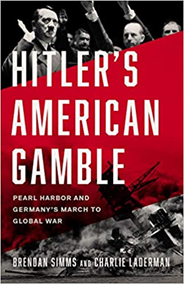
“All too often, historians narrate the past as if the end were preordained at the beginning. But history is not a novel or a play; it is more like a big game, in which the difference between victory and defeat depends on split-second decisions and hair’s breadths. In Hitler’s American Gamble, Brendan Simms and Charlie Laderman grippingly retell the story of five days that not only shook but also shaped the world—the days between the Japanese attack on Pearl Harbor (December 7, 1941) and Hitler’s declaration of war on the United States (December 11). All students of both World War II and the Holocaust will learn, as I did, from their careful use of neglected documents and their attention to ‘counterfactuals’ that, for contemporaries, were at least as likely as what actually happened.” ―Niall Ferguson, Milbank Family Senior Fellow, the Hoover Institution, and author of The War of the World
“Hitler’s American Gamble is a thrilling and authoritative study of five crucial days in the Second World War: December 7–11, 1941. Using a wide array of hitherto-neglected sources and their own deep understanding of the period, Laderman and Simms provide an altogether outstanding account of what transpired between the Pearl Harbor attack and Hitler’s declaration of war against the United States. A gripping tale, expertly told.” ―Fredrik Logevall, author of Embers of War
“Brendan Simms and Charlie Laderman show how Hitler’s mad decision to declare war on the United States on December 11, 1941 proved suicidal for the Axis, ensured a global catastrophe, and would radically redefine how World War II would end. And yet was Hitler really as unhinged and reckless as it has seemed? Warring with America was predictably consistent with the Nazi’s Final Solution ideology. It was consistent with Germany’s allegiance with Japan and the idea of Americans and British suddenly bogged down in a new two-front war—and at the time seen as far more strategically advantageous than allowing a neutral America to continue to supply Germany’s enemies, the British Empire and Soviet Union. Hitler’s American Gamble is revisionist, but in the best sense of sound research, rare originality, singular analysis, and riveting prose.” ―Victor Davis Hanson, the Hoover Institution, Stanford University, author of The Second World Wars